
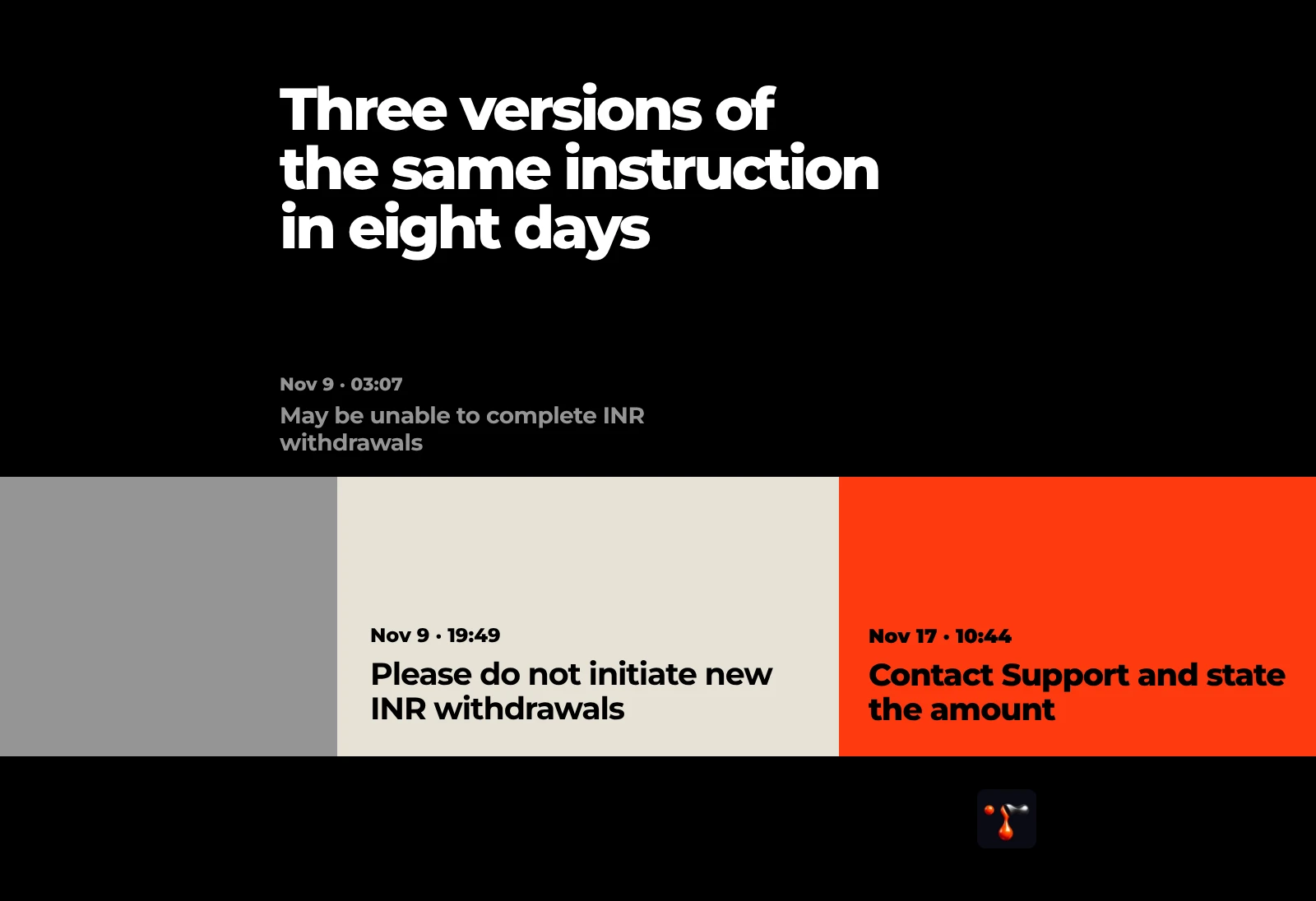
Toeshee runs the support operations behind regulated digital platforms, and risk management is the design principle of that work. In November, four platforms stopped part of their customer transfers because of a problem at an outside company, and each told customers which service was affected. The cause did not change over the days that followed. The instruction did: what a customer should actually do right now. Coinbase posted three versions of that instruction over eight days, and every version had to reach every channel and every shift before a customer acted on an older one.
Who is authorized to speak during an incident is a separate question, covered in The status page said Operational. The customers knew better. This piece picks up after that, when the approved sentence has to be replaced and the old one withdrawn.
What Coinbase published, day by day
Coinbase's status page for its Indian operation is the clearest case, because every version is still posted and timestamped.
- Nov 9, 03:07 PST · Investigating. Customers in India "may be unable to complete INR withdrawals, link new bank accounts, use UPI, or may experience deposit delays due to an outage at our banking partner." Funds are safe.
- Nov 9, 19:49 PST · Identified. Narrowed to INR withdrawals. "Please do not initiate new INR withdrawals at this time," because any started during the period "may fail or remain pending." Deposits, UPI and linking bank accounts "are working normally."
- Nov 17, 10:44 PST · Update. "INR withdrawals remain unavailable due to a banking partner outage." To withdraw, contact Coinbase Support and state the amount; it will be sent to the linked bank account "within 48-72 hours." Failed withdrawals since November 9th are being processed.
Source: status.coinbase.com, incident "Bank Payments Unavailable - INR (India)", read November 23rd. The page carried no resolved entry, and the November 17th route through support is a workaround rather than a restoration.
Read those three entries as a support queue. A customer who saw only the first notice avoided UPI for no reason. By that evening the right answer was to start no withdrawal at all, and by November 17th it had reversed again: contact support and name an amount. Same incident, same stated cause, three different correct answers across eight days.
An agent on the wrong version still describes the outage correctly and still gives the customer the wrong next step, which is the only part the customer can act on. The risk grows with the length of the incident, because every extra day adds channels and shifts that have seen an older version.
The other three incidents were shorter
Coincheck suspended acceptance of crypto transfers after an outage at an external service and canceled transfer requests. Its notice, updated on November 8th, reports that acceptance resumed.
Mercado Pago blocked part of its transfers to external wallets as a protective measure, said deposits "will be credited late," and named a risk-monitoring and anti-money-laundering prevention provider as the source. Buying and selling stayed normal.
Nubank paused crypto deposits and withdrawals to external platforms while buying and selling stayed available, and said operations were restored at 10 p.m. on Friday the 6th. It said the instability was at an external data supplier and did not affect its own infrastructure.
No source shows that these four shared a provider or a root cause, or that any of them was restricted from naming the company involved. Four cases in a month is also not a rate, because nobody has counted how often this happens.
What to do when the instruction changes
Each of these companies published something. The operational question comes after that: when the instruction changes, how does support get the current version to everyone who is about to answer a customer?
This is our recommendation. The sources show what each company published, not how its support team worked.
- Confirm what is affected, in function terms. Not "crypto is down" but which function stopped and which still works. The second Coinbase entry is the model: withdrawals unavailable, deposits and UPI normal.
- Write what the customer should do, not only what happened. "Do not initiate new INR withdrawals" is an instruction. "We are investigating" is not.
- Replace the approved message everywhere at once, and withdraw the old one before the next shift starts. The surviving old version is the problem. An agent reading yesterday's line will deliver it with full confidence.
- If you announce a next update, keep that time separate from a restoration time. We made that case in The hold was right. The complaint still left the building. They are different commitments and customers hear them as one.
- Settle the disclosure question with Legal or Compliance before you need it. Two things to put in writing: what you may say about the provider, and what your regulatory obligations require you to tell customers regardless. Nothing here is legal advice about either.
An example day-one message, not approved copy:
Withdrawals to external wallets are currently unavailable. Please do not start a new withdrawal, as it may fail or stay pending. Deposits, buying and selling are working normally. Our next update will be at [time]. We do not yet have a confirmed restoration time.
How Toeshee helps
We staff chat, email and social, and agents answer from the current approved message rather than their own reading of a status page. When a message is superseded, replacing it across channels and briefing the incoming shift is part of the handover.
Two of our five disciplines, Risk Operations & Fraud Response and Security & Compliance Support, cover transaction monitoring, chain analysis signals and KYC and AML operational support. That is the category Mercado Pago named as the source of its incident, which is why an agent can describe this kind of stoppage accurately instead of guessing at it.
Nothing we operate restores another company's service or releases a transfer that is being held.
Common questions
What should support tell customers when withdrawals are unavailable?
Name the function that stopped, name what still works, say what the customer should do meanwhile, and give the time of your next update rather than a restoration time you cannot confirm.
How long can an incident like this run?
Longer than one shift. On the Coinbase page, INR withdrawals were still unavailable eight days after the first notice, with no resolved entry posted.
Why Toeshee
We work in these industries specifically, across five disciplines, for iGaming, fintech, crypto exchanges, DeFi and crypto payment processors, with iGaming operations aligned to the UK Gambling Commission and the Malta Gaming Authority. Coverage is 24/7, follow-the-sun, in English and Spanish, with over 100 operations specialists. On a service engagement with an unnamed crypto payment processor we reduced resolution time by 54% and sustained a service level of 94% to 96%, figures from that platform's ongoing operation, not from an outage.
Toeshee states that its support operations hold a SOC 2 Type II examination carried out by an independent CPA, covering security, availability and confidentiality.
Who we are
Toeshee provides full life-cycle customer experience management for regulated crypto, iGaming and fintech businesses, with risk management as the design principle of every workflow. Five disciplines, 100+ operations specialists, 24/7 coverage. Request Information →
If the instruction to your customers changes tomorrow, how does your team make sure every channel and every shift has the current version?