
Deposits and withdrawals was the largest valid dispute category at eCOGRA last year. At IBAS, which handles about four times the volume, the managing director has named blocked withdrawals pending identity or source-of-funds checks as the most common theme today. The expensive part is not the check. It is what the operator does in the eight weeks before the customer can take it to an adjudicator.
Two clocks start when a withdrawal is held.
- Complaint clock, set by licence condition 6.1.1. Day 1: acknowledge. Week 8: ADR can open. Fixed. Eight weeks is the outer limit; many licensees aim for 24 hours or five working days.
- Review clock, set by the check. Identity or source of funds. Open-ended: it runs at the pace of the documents and the decision, not the licence.
Schematic, not measured data. Source for the complaint clock: UKGC LCCP 6.1.1 and good practice guidance.
How should operators handle complaints about held withdrawals?
Treat the complaint and the review as two clocks. The review runs at the pace of the check, the complaint at the pace of the licence condition. Conflating them is how a desk ends up with nothing to say.
Of the 411 valid disputes eCOGRA completed in the year to 30 September 2025, 150 were deposits and withdrawals, ahead of responsible gambling at 67 and bonuses at 61. Its categories sum to exactly 411, so the ranking is the report's (eCOGRA, 15 October 2025).
Over the same twelve months the Independent Betting Adjudication Service considered 3,721 disputes, up from 3,223 (IBAS 2024-25 ADR Annual Statistical Report).
IBAS reports continued growth in disputes around identity verification (IBAS 2025 Annual Report). Its managing director, Richard Hayler, told iGaming Expert that the most common theme today is blocked withdrawals pending identity or source-of-funds checks (iGaming Expert, 19 May 2025, upd. 2 January 2026).
Crypto payouts add a trigger with no card or bank equivalent, where the destination address prompts a check. Layers such as Chainalysis or Sumsub speed the review, not the conversation.
A hold is not a freeze
Separate a hold from a freeze in what you tell the customer. The two feel identical to them and are nothing alike to you.
- Hold: stops one payout. Has a defined end: the check clears or it does not.
- Freeze: stops play, deposits and withdrawals together. Stays open until a decision taken outside the support team.
Operators escalate when risk attaches to the account rather than one transaction: suspected multi-accounting, a chargeback pattern, a sanctions or PEP match, a source-of-funds request left unanswered. eCOGRA counts the two apart, 32 locked-account disputes against the 150. We have written before about the account hold as a confidence event rather than a compliance one (A Frozen Account Is a Confidence Event).
Four things carry the complaint while the review stands still
- Acknowledge on the complaint clock. Not the review's. The review may take days. The acknowledgement cannot.
- Name the state. A check on one withdrawal, or a restriction on the account. The customer cannot tell the difference and the two have different endings.
- Ask for everything at once. If the review needs a bank statement, a source-of-funds declaration and a selfie check, ask for all three in the first message, with format and reason.
- Set the next contact and keep it. Give a date you will update them, not a date the review will finish. Update then even if nothing moved.
What must an operator do before a dispute can go to ADR?
Licence condition 6.1.1 requires arrangements that let a customer refer a dispute to an approved ADR entity if it has not been resolved through the operator's own complaints procedure within eight weeks of receipt, provided the customer cooperated in a timely manner. Procedures must give clear information on how to complain, the steps, timescales and how to escalate, and records must be produced to the Commission on request (LCCP condition 6.1.1).
Eight weeks is the outer limit, not the target. The Commission notes many licensees aim for 24 hours or five working days, and expects a clear end point: when you have given your full and final response, say so and signpost the ADR provider, whether or not you use the word deadlock (UKGC good practice guidance).
Why are so many gambling disputes sent back to the operator?
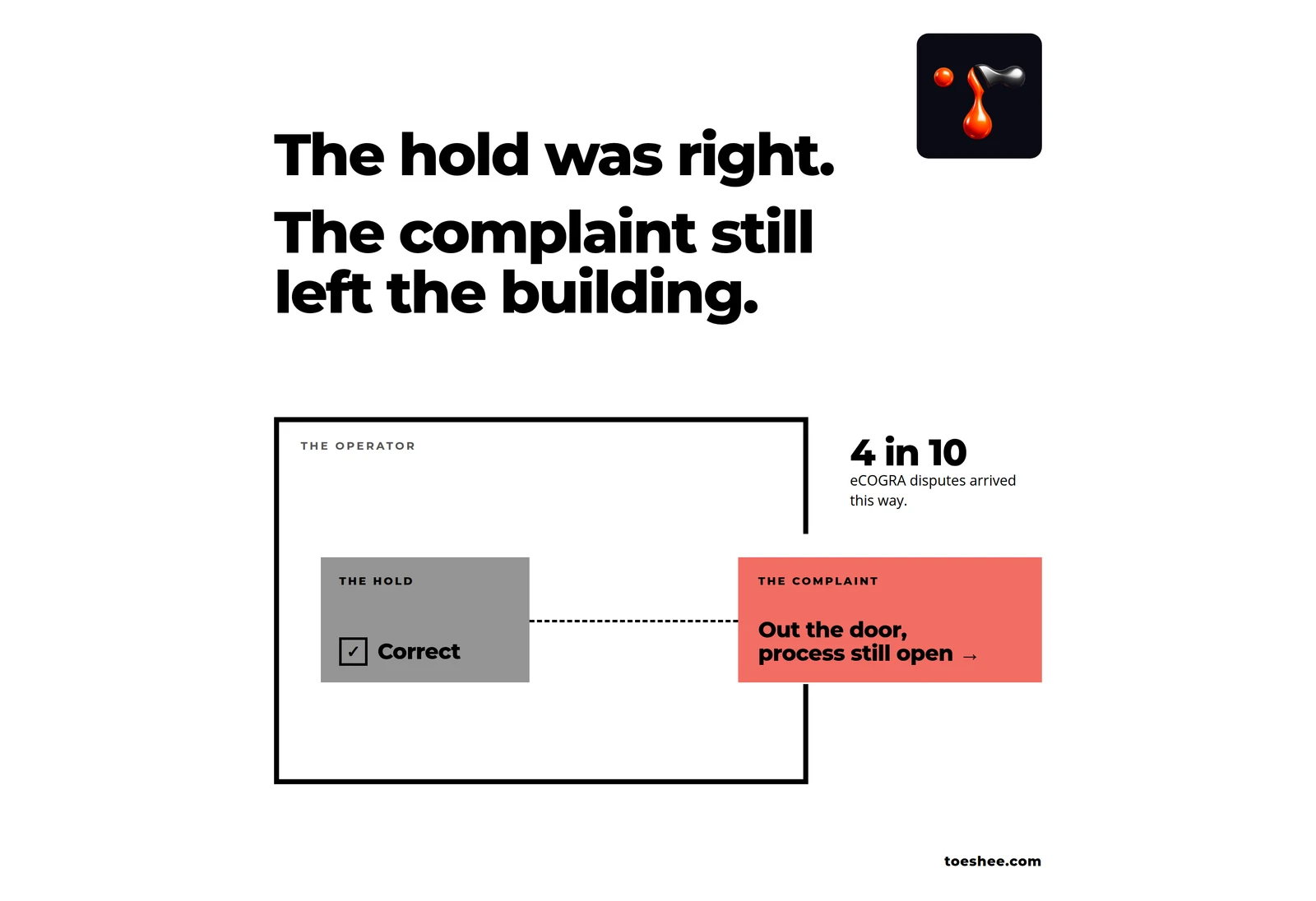
4 in 10 disputes sent to eCOGRA arrived before the operator's own complaints process had finished.
Because the customer arrives before the operator's process has concluded, and the adjudicator cannot take the case. In the twelve months to 30 September 2025 eCOGRA turned away 361 disputes on that ground, 39.6% of everything it received (eCOGRA ADR Annual Report to the Gambling Commission, year to 30 September 2025).
An earlier Commission review of 34 licensee complaints policies, carried out under its 2021/22 business plan, points at where the breakdown sits: procedures buried in terms and conditions, broken links, team names the customer would not recognise, and cases with no record of a complaint raised over Live Chat (UKGC good practice guidance).
The regulator identified the signposting problem and the adjudicator counted the volume. Neither says the two are the same thing, and nor do we. What is not in dispute: at eCOGRA, roughly four in ten disputes are returned because the operator's process was open (Compliance Operations Under Volume Pressure).
Who owns the ticket while it waits
The held-withdrawal complaint lands in a state most queues are not built for. Support can neither progress nor close it, so it ages out of view until the customer chases. Name an owner for the life of the hold, with a cadence independent of the review.
- 20 days: IBAS average to resolve a domestic dispute.
- 31 days: eCOGRA average to resolve a domestic dispute.
- 9 days: IBAS wait for the operator's file.
For scale: the adjudicators' averages to resolve a domestic dispute, and IBAS's wait for the operator's file. Each publishes on its own basis, so read them as two benchmarks.
What can support tell a player during a compliance review?
More than most teams assume. The Commission's position is that customers should be informed why a withdrawal has been delayed, and that where one is refused the operator should give a full explanation including the basis for it. It also asks operators to make proper efforts to explain what the checks and restrictions are, and recognises one limit: where tipping-off restrictions apply, what you can say is constrained (UK Gambling Commission, 18 July 2024).
So the answer has two halves. Most holds are not tipping-off situations, and there the default should be explanation rather than silence. A minority are, and there the team needs to know in advance which script applies and who authorises it. That is a determination for your counsel. Nothing here is legal advice.
What stays sayable, enough to hold the relationship:
- The account is under review.
- This is a standard check, not an accusation.
- What we need, and in what format.
- Who is handling it.
- When you will hear from us next.
- Confirmation that the funds are intact.
The outcome data shows what escalation buys. Of the 1,495 disputes IBAS completed, 65 were upheld by written decision. eCOGRA reports ruling for the operator in 82.2% of its dispute conclusions, though that spans every dispute type and the report does not publish the base. Operators are not generally losing these cases. They absorb the handling cost, the file request and the regulator's attention on a process they are licensed to run properly.
Four questions worth answering this week
Pull last month's held withdrawals:
- Do your complaint clock and review clock run separately, and does the customer see the first one?
- Can a customer find your complaints procedure without opening your terms and conditions?
- Does anything tell the customer, in plain words, that you have given a final answer and who they can go to next?
- How many customers reached an adjudicator while your process was still open?
If you cannot answer the last one, instrument that first.
The complaint clock is the one your customer is watching
Toeshee builds specialized customer support for iGaming, fintech and digital-asset platforms, run by people who know what an AML hold is before they answer the first message. We treat the support desk as a risk management surface, where the conversation decides whether a correct decision reads as competence or as a wall.
We've got your back. Crypto-native.