
The channel that answers is the one that matters
Toeshee builds specialized, scaled customer support for iGaming, fintech and digital-asset platforms, and the three numbers above are one failure wearing three outfits: something breaks, and what decides the next hour is not when it gets fixed, but who is telling the customer anything at all, and whether it is true.
Rank these by what broke first in the communication itself, not by the size of the outage. The order below runs from the wrong answer, to no answer, to a true answer measured against the wrong base.
Incident 01: Wrong information
Sportsbook Rhode Island · 7 September 2025
Sportsbook Rhode Island, the state lottery's wagering app, went down for about 75 minutes on 7 September 2025, the first Sunday of that NFL season. The app's first message to customers called it planned maintenance. The Rhode Island Lottery later corrected that in public:
“This was unexpected and not a planned maintenance outage.”
The Lottery apologized, and the sportsbook added a $5 bonus bet to all customer accounts. The failure here was not the outage. It was that the first thing customers were told was false, and the state lottery had to say so.
Incident 02: No information
PayPal · Venmo · 1 August 2025
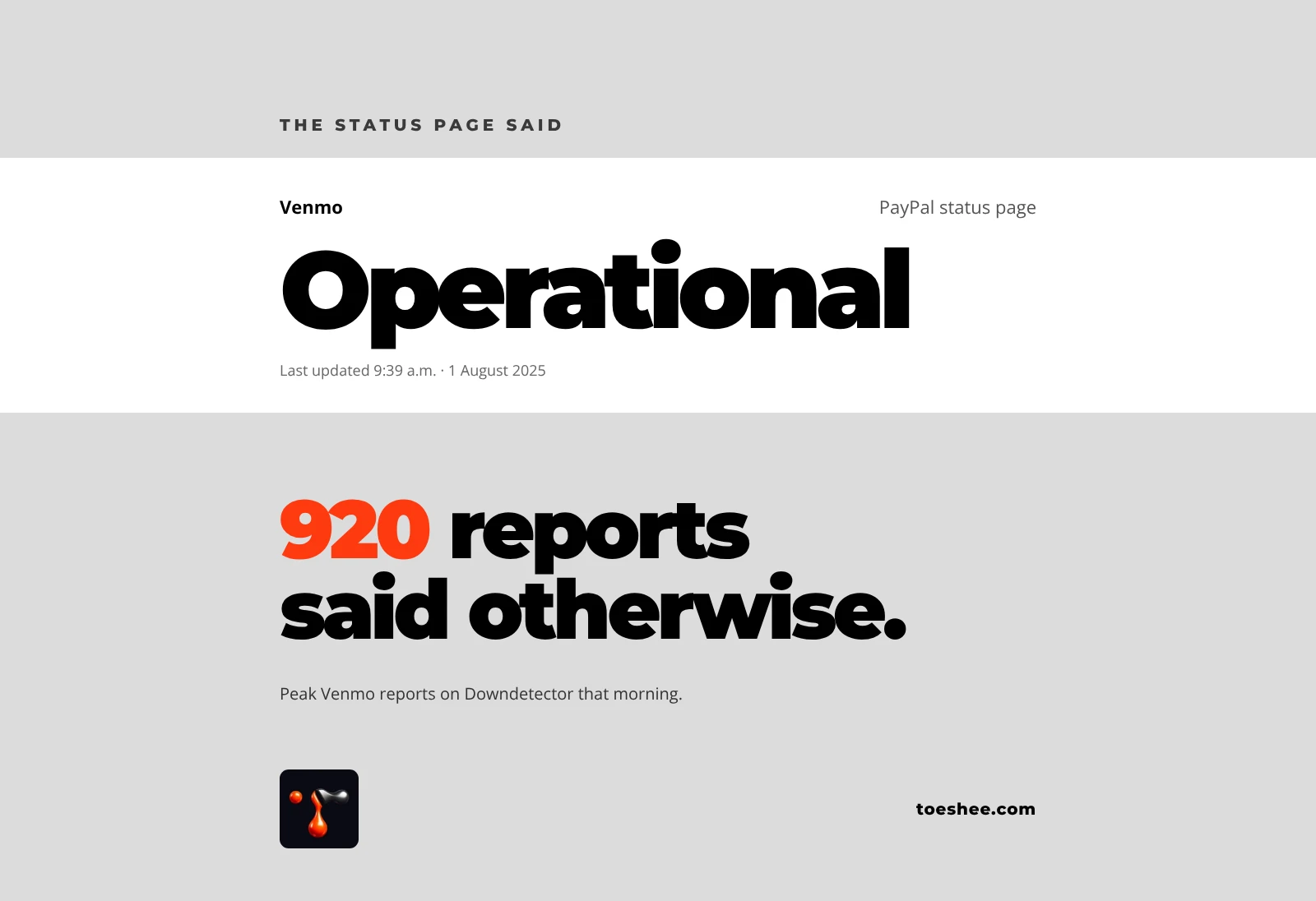
PayPal's status page described “a system issue” affecting Online Checkout and Braintree on the morning of 1 August 2025, then narrowed the listed disruption to Reporting as hours passed. PayPal spoke to the press only once, hours in: “PayPal and Venmo experienced a temporary interruption this morning that has since been resolved,” its first acknowledgment that Venmo, its own product, had been down at all.
- Venmo, on PayPal's status page: Operational
- User reports on Downdetector, peak: ~920
- Posts from Venmo on social media: 0
1 August 2025. Source: Tom's Guide.
Venmo itself posted nothing, while Downdetector reports for the app peaked near 920 and PayPal's own status page listed Venmo as “Operational” the entire time. A platform with a working status page said the wrong thing by omission.
Incident 03: True, measured against the wrong day
Binance · 1 November 2026
Binance reopened withdrawals on 1 November 2026 after a hack, and posted its own numbers on X: $4.65 billion withdrawn, $1.01 billion deposited, a net outflow of $3.64 billion in the first nine and a half hours, described as 2.1% of assets.
Binance's assets before the hack, two measures:
- Binance's own proof of reserves, 28 October: $171 billion
- Binance-linked wallets tracked by DefiLlama: ~$144 billion
Binance calculated the 2.1% on the larger figure. The two sources count assets differently, so the gap is a difference in method, not a loss. Sources: Binance on X, via The Block and CNBC; DefiLlama via CoinDesk, 29 October 2026.
That 2.1% was measured against $171 billion in proof-of-reserves data dated 28 October, the day before the theft. An independent tracker, DefiLlama, put Binance-linked wallets at roughly $144 billion before the hack, and about $131 billion on 1 November, the day withdrawals reopened. Co-founder Changpeng Zhao then posted, on his own account, “98% choose to stay!” No source ties that figure to the 2.1% net outflow; the arithmetic match is Toeshee's own reading, flagged here, not three sections later. Nothing in the numbers is false. The base they are measured against is not the one a customer would assume.
See where your own escalation path breaks before it has to answer for you. Request a communication-readiness review →
The spend goes to uptime, not to the sentence someone has to say
All three had a working channel. Rhode Island's app came back in 75 minutes. PayPal's checkout returned by afternoon. Binance's withdrawal queue processed billions within hours. The infrastructure held, or recovered fast.
None had a pre-cleared, accurate sentence ready for the first ten minutes: who is authorized to say what, before a regulator, a journalist, or a founder's personal account becomes the only source a customer can find.
Capacity planning gets a budget line. The sentence does not.
What generalist AI cannot be handed
Toeshee is a vendor here too, which does not exempt the claim. A chatbot can post a status update the instant a system flags an incident, useful for the routine case. What it cannot be given is authority: standing to correct a regulator's or a company's own prior statement, with the accountability that carries if it is wrong.
That authority sits with a person a regulator can call, which is a compliance and liability question, not a language one, and it is why no better model closes this gap. Generic outsourcing fails the same way from the other side: a vendor without pre-delegated authority waits on sign-off that was never arranged, which is how a status page ends up reading “Operational” while users report otherwise by the hundreds.
A diagnostic worth thirty minutes
Write down who is authorized to post an external correction during an incident, and how long it takes them to get sign-off.
If the honest answer is “it depends” or “whoever is online,” you already know what your status page will say next time, and you will not like it.
What this piece does not say
The Binance situation is still developing. A full cryptographic proof of reserves was expected on 3 November, and no root-cause report for the hack was public as of this writing; treat the Binance facts here as current to 2 November 2026, not as a closed case.
None of the three companies published an internal policy on who may speak during an incident; the claim that each failure traces to an undelegated decision is Toeshee's reading of what the record does not show, not a claim any of the three made about itself.
Common questions
Isn't this just a PR problem, not an operations problem?
No. Every case above shows a channel that was technically live and still gave the customer the wrong picture, by being wrong, by being silent, or by being accurate on terms the customer never agreed to. That is a staffing and authority question, not a wording question.
Didn't Binance actually communicate more than the other two?
By volume of posts, yes. By information that would change a customer's decision, no more than the other two: the headline figure used a denominator from before the event it was meant to explain.
What would change by the next incident?
Specialized, scaled support means the first sentence is drafted and the person who can say it is named before the incident, not during it, and that the figure in that sentence is checked against what actually changed, not what was true yesterday.
Risk is the layer above all of this
None of these three companies lied in the way the word usually means. One corrected itself late. One said nothing while its own dashboard said the wrong thing for it. One told the truth using a number from the day before.
Toeshee runs specialized, scaled customer support for iGaming, fintech and digital-asset platforms as a risk function, built on verifiable operational discipline and SOC 2 compliance, so the first sentence a customer sees during an incident is accurate, owned, and said by someone with the authority to say it.
The sentence is the risk. We’re built to own it.