
A freeze is a compliance necessity and a trust event at the same moment. The trigger is not optional, and roughly 92% of centralized exchanges now run identity verification. What is not mandated is how the hold is operated: how fast the desk explains it, whether every agent gives the same answer, whether funds return on a defined clock or disappear into an open-ended review. The check settles the obligation. The operation settles whether the user comes back or files a complaint.
The identity check answers one question: is this user, this transfer, and this source of funds clean enough to let money move. It does not answer the question the frozen user is actually asking — is my money gone, and does anyone here intend to give it back. Those are different questions, and the second is answered at the support desk in the first hour of the hold. An account under review is not a paused ticket. It is a person locked out of their own funds with no timeline.
What a freeze looks like from the desk
The pattern is well documented in public complaint records. A user deposits, trades normally for weeks, turns a profit, and requests a withdrawal — and at the withdrawal, not before, risk control activates and the account is frozen pending verification. From the user's side, the sequence reads as a platform that was happy to take deposits and went cold at the exit. From the desk's side, three things are true at once:
- Total and personal. Unlike a depeg that frightens a market, a freeze locks one identifiable person out of a specific balance, and every message they send is written in that state.
- Clock undefined. Standard reviews clear in one to three days, enhanced reviews run to fourteen, some windows stretch to thirty — extendable to a hundred and eighty, with documented cases past a year.
- Irreversible. A release to a genuine bad actor is a penalty. A blanket hold on a legitimate user is the complaint that same regulator reads later.
Nearly every freeze falls into one of a small set of trigger families: an automated security hold, AML risk scoring of incoming coins, a sanctions-screening match, a source-of-funds review, a law-enforcement order, and a growing sixth — business de-risking. The trigger is legitimate in each case, and it is not what turns a routine safety check into a churned customer and a public complaint. The operation is.
Why the operation, not the trigger, decides the outcome
The enforcement environment makes the trigger non-negotiable. No operator gets to stop freezing. $1.23 billion in AML, KYC, and sanctions fines was issued in H1 2025 — a 417% jump over the same period the prior year on major global exchanges — and 99+ jurisdictions have the Travel Rule enacted or in progress, with FATF Recommendation 15 extending AML/CFT obligations to virtual-asset firms. That part is settled.
What is not settled is the outcome of the freeze, and the public record shows how wide the gap runs. The U.S. Consumer Financial Protection Bureau documented more than 8,300 crypto-asset complaints in a single reporting window, with users reporting frozen accounts and an inability to access their own assets. One large exchange's file in that database ran to nearly five hundred complaints, and every one was closed with an explanation and zero monetary relief. That is the shape of a freeze operated as a compliance event and nothing more: the obligation is met, the user is gone, and the only durable artifact is a complaint on a regulator's desk.
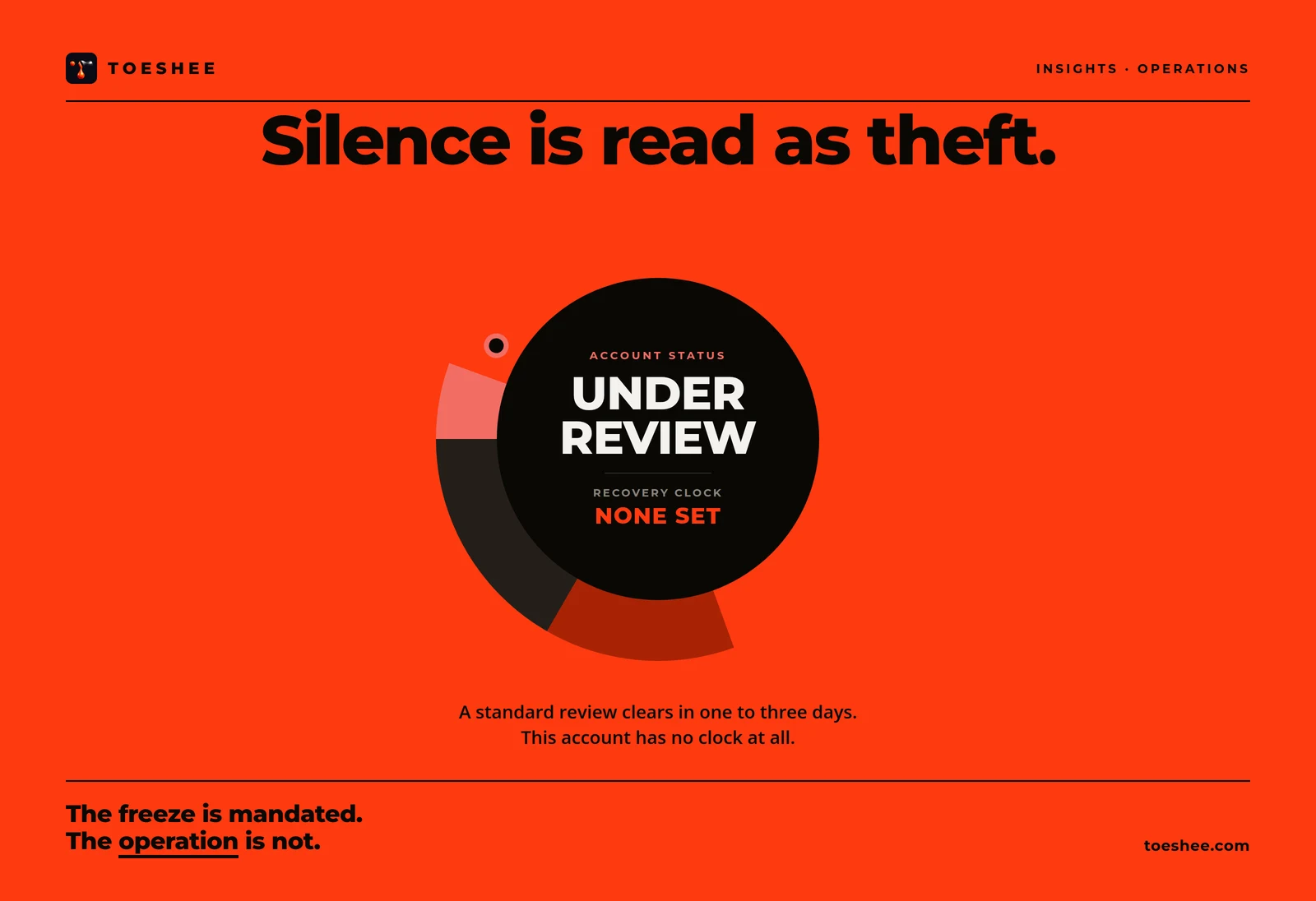
In a lockout, silence is not neutral. It is read as theft — and the user acts on that reading.
What separates a freeze that holds trust from one that becomes an exit
Read across the documented complaint patterns, four operational practices separate the freezes that retained a customer from the ones a safety check turned into an exit — the closest thing to a reference architecture for the moment an account is held.
1. Explain the freeze the moment it lands
Held trust: told the user immediately, in plain language, what triggered the hold and what happens next — even when the AML answer had to stay generic.
Became an exit: went silent, leaving the user to conclude the only thing silence implies during a lockout: that the money is gone.
2. Put a defined clock on recovery, and hold it
Held trust: attached a named window and a concrete proof-of-funds path to the hold, and met the window they set.
Became an exit: left the account in open-ended "under review" — the same status whether it clears in a day or a year. A user with no timeline has no reason to wait rather than file.
3. Give one answer, everywhere, from every agent
Held trust: ran a single calibrated position across agents and channels. Consistency during a lockout reads as control.
Became an exit: gave three different answers in an afternoon. The user told two incompatible things stops believing there is a process at all.
4. Keep the irreversible calls disciplined — separate risk from routine
Held trust: ran genuine AML and sanctions signals through enhanced review while moving clean false positives through a fast lane.
Became an exit: applied one blanket hold to everyone, treating every customer as a suspect. Efficient for the queue, corrosive for the book.
None of the four holds alone. A blanket freeze with a clear explanation is still an abandonment; a fast clock with three inconsistent answers still reads as chaos. The operations that keep the customer run the four as one rehearsed system, so the freeze is a controlled event with a defined end.
Where generalist AI fits, and where it doesn't
Generalist AI agents optimize cost per ticket, and for the routine layer around a freeze — status checks, document-upload instructions, FAQ on what verification requires — that is the right tool. So automate the calm status query, every one.
The freeze decision itself is the opposite of routine: judgment under a frightened user's pressure, on an irreversible call, with the regulatory clock running and a real balance locked. Cost-per-ticket optimization is efficient at exactly the work that should never be cheap. SOC 2-compliant operations and an audit trail on every hold-and-release are what let that decision survive both the user and the regulator.
What this looks like in practice
Operating a freeze well is an architecture, not a headcount added after the complaints arrive. In work with a regulated crypto payment processor, restructuring the support operation around specialized roles and compliance-aligned workflows produced a 54% reduction in resolution time, a 75% cut in first-response time, and a 94–96% service level sustained.
The metric that matters at a freeze is not average handle time. It is whether the user who was locked out on Monday has an answer, a timeline, and a path by Tuesday — or a grievance by the end of the month.
A diagnostic worth thirty minutes
Five questions for the operation that freezes and recovers your customers' accounts, framed the way a post-incident review would ask them.
- When an account is frozen, who tells the user what happened, on which channel, within the first hour — or does the user learn it from a failed withdrawal and silence?
- Does every held account carry a defined recovery clock and a concrete proof-of-funds path, or does "under review" mean the same thing at day one and day ninety?
- Does every agent and channel give one calibrated answer about a hold, or does each improvise?
- Can you separate a genuine AML or sanctions signal from a clean false positive, so a legitimate user is not held on the same track as an investigation?
- Have you rehearsed a freeze-and-recovery flow with named owners and a service level, or is the first frozen customer the first rehearsal?
The unanswered questions are the map of where a safety check turns into an exit — worth a half hour of your team's time regardless of whether Toeshee is part of the conversation.
Common questions
Why is a frozen account an operations problem, not just a compliance problem?
Because the freeze can be fully justified and still cost the customer. The trigger is mandated, and roughly 92% of exchanges now run it. What decides whether the user comes back or files is operational: how fast the desk explains the hold, whether recovery runs on a defined clock, whether every agent gives the same answer. Compliance settles the obligation; the operation settles the relationship.
Can generalist AI handle a frozen-account case?
For the routine layer, yes: status, document instructions, FAQ. Not for the freeze decision itself — judgment under a frightened user's pressure, an irreversible call, the regulatory clock, and a locked balance all at once. That is the risk-bearing work a deflection layer cannot hold.
How long should a hold take, and what does "good" look like?
Standard reviews clear in one to three business days, and enhanced reviews can legitimately run longer. The failure is not the duration but the absence of a clock. A well-operated hold tells the user what triggered it, attaches a named window and a proof path, holds that window, and routes clean false positives away from genuine investigations.
Toeshee is the specialized customer-support partner for iGaming, fintech, and digital-asset platforms, operating the support layer with risk management and compliance as the design principle of every workflow — SOC 2-compliant operations, risk-tiered escalation discipline, and disciplined handling of the moments a user's trust is tested.
We've got your back. Crypto-native.