
A customer gave an online betting operator pay stubs showing earnings of about $2,700 a month, then deposited and lost $12,275 in four days. Toeshee runs customer contact for operators in regulated industries, and our agents are among the people who receive documents like these. In this case, the pay stubs were already in the customer's file, and the operator's controls did not act on them in time.
1. Pay stubs the operator already had
On August 20, 2026, the UK Gambling Commission announced that QuinnBet (Gibraltar) Limited would pay $830,757 for regulatory failures. Its anti-money laundering findings include the customer described above, who had provided pay stubs showing about $2,700 a month and then lost $12,275 in four days. The Commission found that QuinnBet had insufficient controls to act in a timely manner on customers displaying disproportionate spend.
The Commission's findings do not mention customer support. Comparing spend against declared income is the operator's job, and with our clients it stays with them. In our view, what a contact team can add is making sure the documents and signals it receives reach the team that makes that call, and that each contact is on record.
2. A restriction the bank repeatedly failed to apply
On July 8, 2025, the Financial Conduct Authority (FCA) fined Monzo Bank Limited $28.6 million for financial crime control failures, a 30% settlement reduction from $40.9 million. Monzo was under a requirement that barred it from opening accounts for high-risk customers. Between August 2020 and June 2022, it signed up more than 34,000 of them anyway.
The FCA's Therese Chambers said that Monzo "onboarded customers on the basis of limited, and in some cases, obviously implausible information," such as customers using well-known London landmarks as an address.
Chambers added that this "was compounded by its inability to properly comply with the requirement not to onboard high-risk customers." In our view, a landmark given as a home address is the kind of signal a person reading the application could catch, and a rule that sits in a policy document and not in the process that opens accounts does not work as a control.
Want to see how our agents would work inside your accounts? Ask Toeshee about a pilot. Request Information →
3. Transactions the system did not monitor
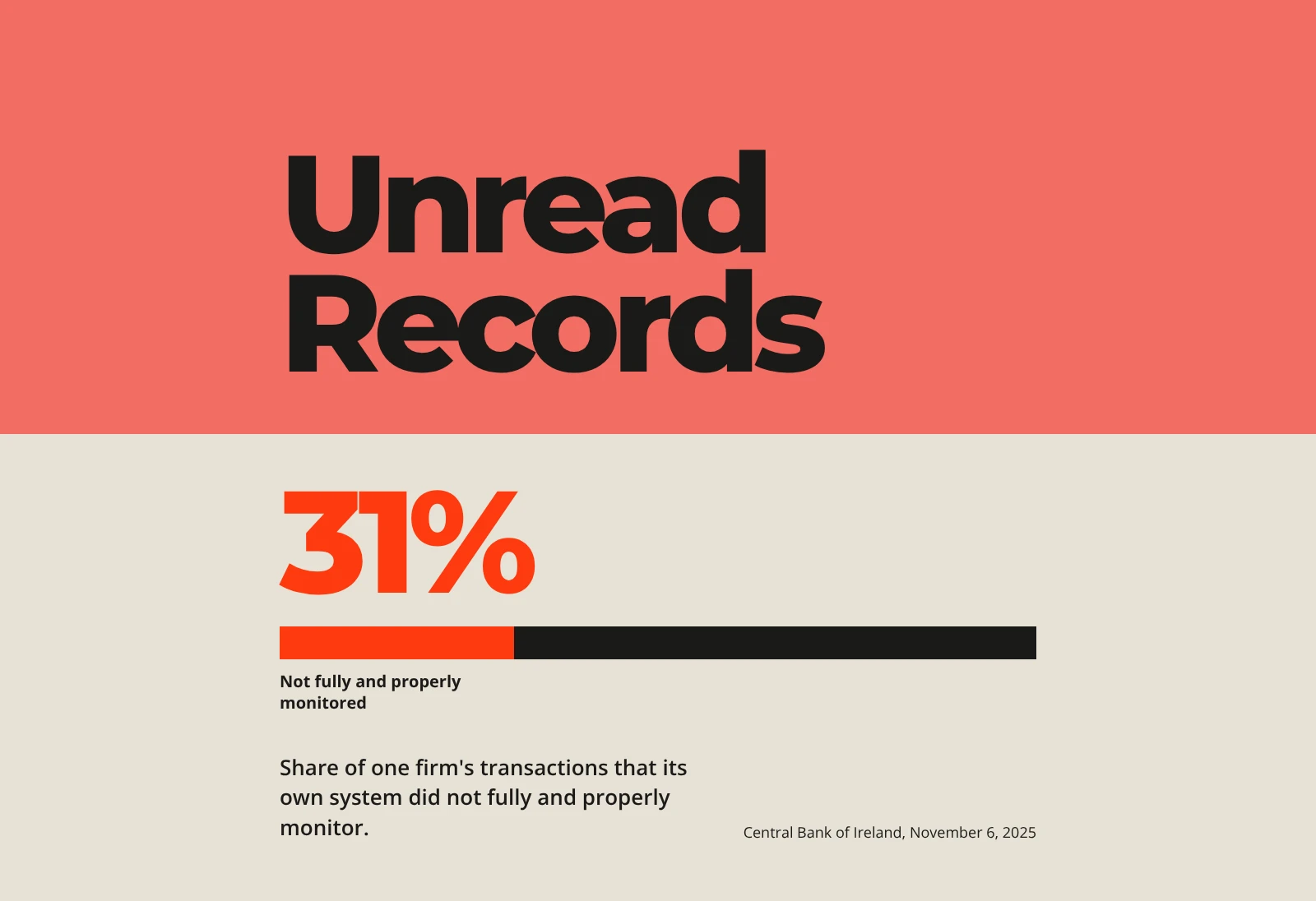
On November 6, 2025, the Central Bank of Ireland fined Coinbase Europe Limited $24.8 million, a 30% reduction from $35.4 million. Over a 12-month period, faults in how its transaction monitoring system was configured left 30,442,437 transactions, worth more than $203 billion and about 31% of the total, not fully and properly monitored. The firm later filed 2,708 suspicious transaction reports. Coinbase Europe admitted the contraventions. We covered the screening side of this case in A Checkbox That Ran, and Did Not See.
This gap sat in system configuration. In our view, a support desk would not have closed it. We include it because the question it raises applies to every control, ours included: what share of the traffic does it actually read?
Each firm had something to work with: QuinnBet had the customer's own pay stubs, Monzo had a clear regulatory requirement, and Coinbase Europe had a monitoring system. In each case, the regulator found that the firm's controls did not make effective use of it.
What we are claiming, and what we are not
This analysis has four limits. First, these are three enforcement actions we selected, two from 2025: individual cases, not a sector statistic. Second, every figure comes from the regulator's own announcement or public statement, checked word for word on November 9, 2026, and converted to US dollars at the Federal Reserve rate on each announcement date; where we characterize rather than quote, the characterization is ours. Third, none of these regulators mentions support operations. The argument that a contact layer helps close part of this gap is ours, as is the section below on AI models and outsourcing incentives. Fourth, what we say about our own operation describes how it is built. We have not measured it.
Why Toeshee: agents who work inside the account
Our agents work inside the player account. They review deposits and withdrawals, receive the documents customers send, and take part in KYC and AML checks on whether a customer is legitimate.
When a customer sends documents, our agents pass them to the department responsible for reviewing them, and when something in an account needs attention, they report it to the client. The client sets the procedures and makes the decisions. Our part is making sure what the agent saw reaches the people who decide, and we treat what is critical to the client as critical to us.
Responsible gaming is part of the job too. If a player says something that goes against the client's procedures, the agent reports it to the client, and if a player asks to be limited because they have a problem, we apply the limit.
We train our people on each client's risk profile and scripts, including crypto cases such as withdrawals held for screening or stablecoin transfers routed into flagged clusters.
Each account is reviewed in a dedicated tool, and every interaction leaves a written record.
Our agents work under Multi-Dimensional Security, the desktop controls that confirm the agent is alone, flag unauthorized devices, and restrict access to approved locations.
Where general-purpose AI and generic outsourcing fall short
Toeshee is itself an outside provider, so the same questions apply to us.
A general-purpose AI model working from your policy documents can describe your restriction accurately, but it has no way to tell whether your systems enforce it.
Generic outsourcing has a simpler problem: a vendor measured on tickets closed has little reason to pass along what it sees in the account.
We are SOC 2 compliant, with a Type II report covering a defined set of controls over a defined period. It describes how we work, and it says nothing about whether your own controls read your records.
A three-question self-check
Pick one customer file from last quarter that your systems treated as normal, and answer these three questions in writing.
- What did you know about that customer at the time of their largest transaction, and which of those fields did a control actually read?
- Which of your written restrictions are enforced in the account-opening process itself, rather than by someone remembering them?
- For each monitoring control, what share of eligible traffic did it cover last month, and can the control report that on its own?
If the third question takes more than a day to answer, you don't know your coverage.
Common questions
We pass our audits. Does this apply to us?
It can. Coinbase Europe had a transaction monitoring system in place during the 12 months when about 31% of its transactions were not fully and properly monitored. An audit shows that a control exists; check separately what share of your traffic it actually covers.
Is this only a crypto or gambling problem?
No. One of the three cases is a bank: Monzo onboarded more than 34,000 high-risk customers while under a requirement not to.
Who we are
Toeshee provides specialized customer support for operators in iGaming, fintech, and digital assets. We handle player and customer contact, account and transaction review, KYC and AML support, and responsible gaming requests, following each client's procedures from onboarding through the life of the account. Compliance is built into how we design every workflow. We work discreetly and name clients only with their permission.
Sources
- Central Bank of Ireland, enforcement action against Coinbase Europe Limited, November 6, 2025
- Financial Conduct Authority, FCA fines Monzo £21m for failings in financial crime controls, July 8, 2025
- UK Gambling Commission, QuinnBet (Gibraltar) Limited to pay £609,104 for regulatory failures, August 20, 2026
- UK Gambling Commission, QuinnBet (Gibraltar) Limited public statement, August 20, 2026
- Board of Governors of the Federal Reserve System, H.10 foreign exchange rates via FRED, series DEXUSUK and DEXUSEU
You already have the record. Make sure it reaches the people who decide.