
The problem: the record was already there
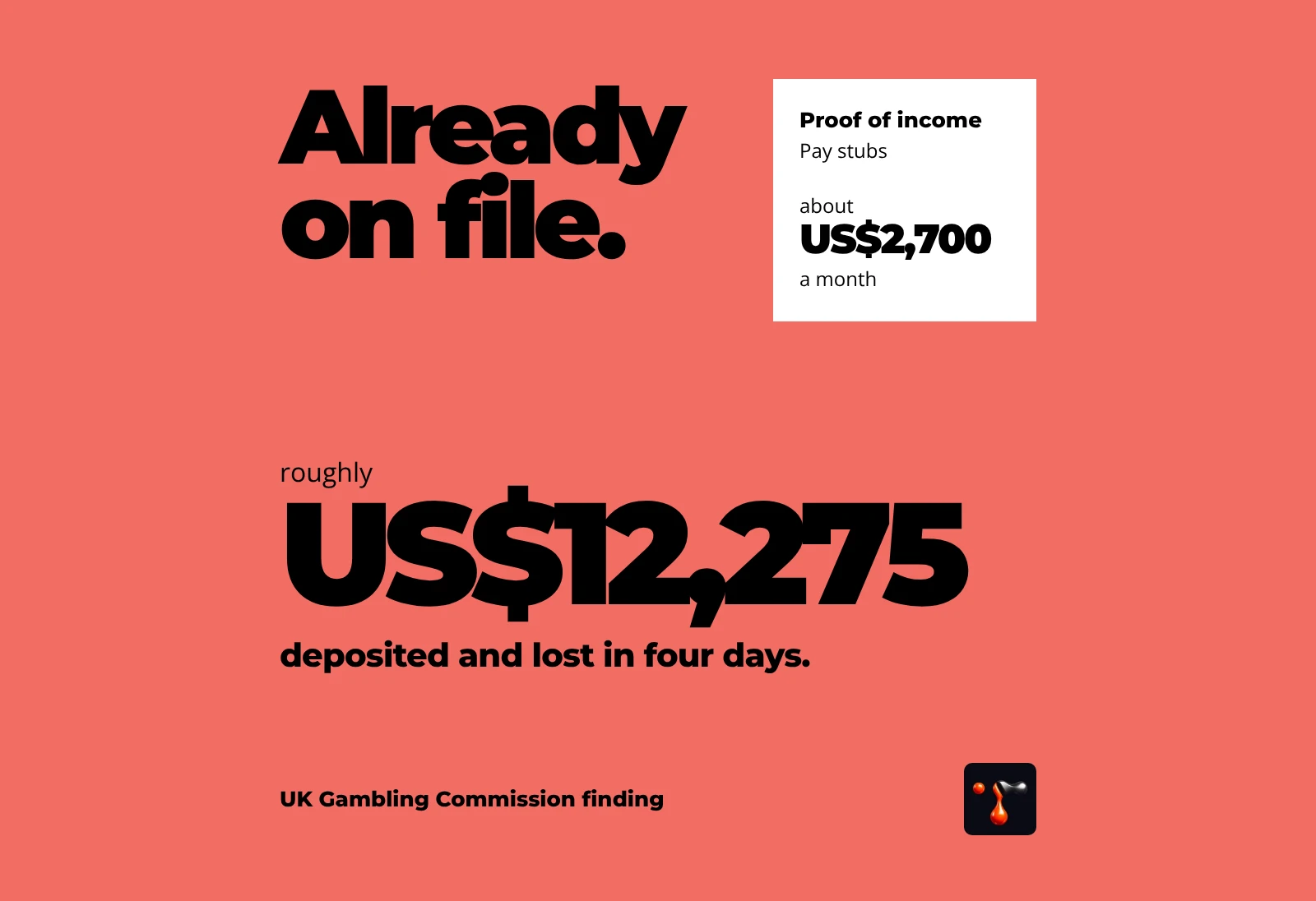
A player gave an online betting operator payslips showing monthly earnings of about US$2,700. The player then deposited and lost roughly US$12,275 in four days. The documents were already on file. The UK Gambling Commission found that the operator did not intervene adequately on those signs of disproportionate spending (UK Gambling Commission; the statement gives £2,000 and £9,000, converted here to US dollars).
- Proof of income, on file: payslips, about US$2,700 a month
- Deposited and lost: roughly US$12,275, in four days
The same operational question comes up across regulated markets
- Monzo: 34,000+ high-risk customers signed up while a restriction was in force (Financial Conduct Authority).
- Coinbase Europe: ~31% of transactions over a 12-month period were not fully and properly monitored, because of configuration faults (Central Bank of Ireland).
In each case, the firm had a record, a rule, or a system in place. The question was whether it shaped what happened next.
The support queue is one place to look for that gap
For Web3 and iGaming operators, each interaction has a customer service task and may also require a risk or compliance action:
- A player says they're losing control.
- A customer asks why a crypto withdrawal is on hold.
- Someone uploads proof of income.
If you pulled one of those cases today, could you see what the agent knew, who received it, and when someone acted?
The solution: Toeshee
Toeshee is a specialized BPO purpose-built for Web3 and iGaming. We run customer operations for platforms where handling a withdrawal, reviewing an account, or responding to a player can carry real risk. Our agents work in your tools, inside the customer account, with training built around your platform, your risk profile, and your escalation rules.
Here's what that looks like in practice
iGaming. When a player sends proof of income, the agent routes it to the designated reviewer with the relevant account context. If a player asks for a limit, the agent can apply it under your responsible gaming procedures and document the action.
Web3. When a customer asks about a held withdrawal, an agent who understands wallet and transaction flows can review the account, distinguish a transaction issue from a screening hold, and send the case to the right team with the details it needs.
In both, the interaction and the handoff leave a written record. Your team sets the rules and owns the compliance decisions. Toeshee makes sure the information your agents receive reaches the people who need it.