
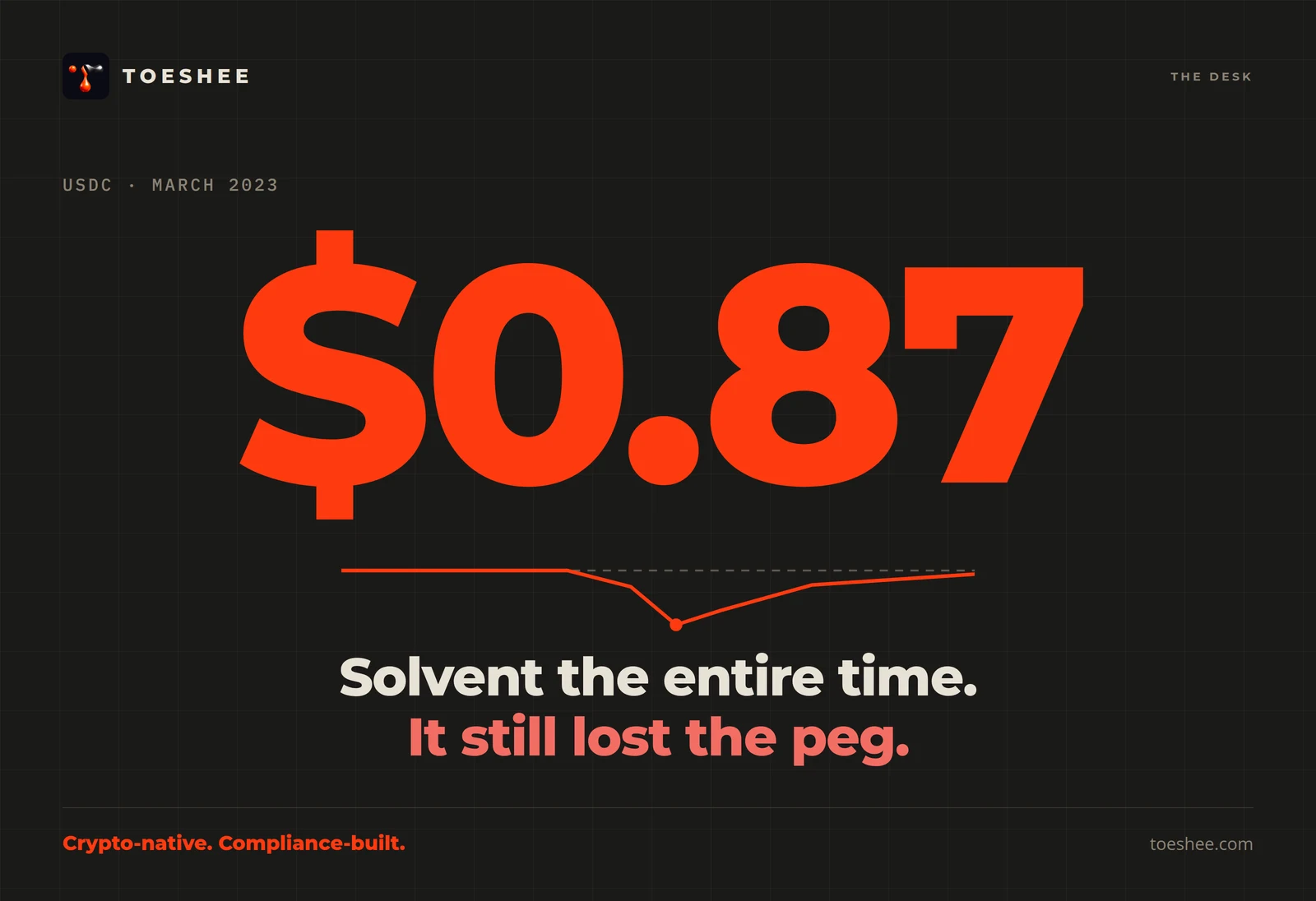
In a confidence event, a stablecoin's stability is operated, not just backed. In March 2023, USDC was solvent the entire time and still fell to $0.87. What determined how deep the depeg ran, how long it lasted, and who came back was operational — and it played out on the support desk. That operation is designed before the event, not assembled during it.
What a confidence event looks like from the desk
On Friday 10 March 2023, regulators shut Silicon Valley Bank. That evening Circle disclosed that $3.3 billion of USDC's roughly $40 billion in reserves — close to 8% — was stuck at the failed bank. By 2 a.m. Saturday, USDC had fallen below $0.87. Nothing had been hacked and the system had not failed. It was a confidence event, and it landed in one place: the operations and support desk of every platform that touched USDC.
From the desk, three things happen at once:
- Volume spikes five- to tenfold within minutes — and because a crypto rail has no market close, it happens at 2 a.m. on a Saturday exactly as it would midweek.
- Every ticket is high-stakes and time-compressed — the user is frightened and moving money, so a slow or inconsistent answer doesn't merely frustrate, it accelerates the run.
- Every call is irreversible — a withdrawal released to a panicking user is final, and a freeze applied in error, reading panic as fraud, is final too, and becomes a complaint the regulator later reads.
The extreme version: when Terra's UST depegged in May 2022, the first slip on 8 May became a stampede once confidence broke, and roughly $45 billion evaporated in a week — with panic spilling into unrelated tokens. Contagion means the desk fields the fear of the whole market.
Why the operation, not the balance sheet, decides the outcome
USDC re-pegged within days, once the FDIC backstopped SVB depositors and Circle resumed redemptions on Monday 13 March. Solvency was ultimately confirmed on the balance sheet. But the depth and duration of the event were operational: the weekend suspension of primary-market redemptions itself added to the selling pressure, and platforms that went quiet or gave inconsistent answers lost users who did not come back, while those that communicated clearly held their book.
A stablecoin can be fully solvent and still lose its peg for days on confidence alone.
The standard the operations that held actually used
Read across the documented events, four operational patterns separate the operations that held a confidence event from the ones a wobble turned into a run — the closest thing to a reference architecture for the moment the peg comes under pressure.
1. Fill the information vacuum before rumor does
Publish what's happening and the redemption timeline fast, in plain language, on every channel. Go silent and rumor fills the vacuum — the mechanism that turns a wobble into a run.
2. One answer, everywhere, from every agent
Run a single calibrated position across agents and channels; consistency reads as control. Three different answers in an hour manufacture the instability the user already feared.
3. Honor redemption on the clock — and keep the irreversible calls disciplined
Redeem at par within the regulatory window even while the secondary market trades below peg, and separate genuine panic from fraud. Ad hoc freezes signal distress — and a pause can itself deepen the depeg.
4. Surge capacity in place before the event
Carry elastic, trained coverage able to absorb five to ten times normal volume, 24/7. Without it you produce a queue — and a queue during a run pushes users toward the exit rather than an answer.
None of the four holds alone. A confidence event gives no time to assemble them live; the operations that hold run the four as one rehearsed system.
Where generalist AI fits, and where it doesn't
Generalist AI agents optimize cost per ticket, and for the routine layer — balance checks, status, FAQ — that is the right tool. A confidence event is the opposite of routine: it's judgment under panic, on irreversible decisions, with the regulatory clock running and trust on the line. So automate the calm day; the hour the peg wobbles is a different job entirely, and deflection was never going to hold it. A support operation rehearsed for the surge is what does — and SOC 2-compliant operations are what make that hour hold.
In work with a regulated crypto payment processor, restructuring support around specialized roles and compliance-aligned workflows produced a 54% reduction in resolution time, a 75% cut in first-response time, and a 94–96% service level sustained — the discipline that lets a desk absorb a surge intact rather than degrading exactly when the load peaks.
A diagnostic worth thirty minutes
Five questions for the operation serving your stablecoin flows — internal or partner-operated — framed the way a post-incident review would ask them.
- When a stablecoin you hold or move wobbles, who publishes what, on which channels, within the first hour — or is that decided live?
- Does every agent and channel give one calibrated answer in a confidence event, or does each improvise?
- Can you honor redemption at par on the regulatory clock while the market trades below peg, without ad hoc freezes that themselves signal distress?
- Can the operation absorb five to ten times volume, 24/7, without the queue becoming the accelerant?
- Have you rehearsed a depeg or contagion scenario with named owners — or would the first run be the first rehearsal?
The unanswered questions are the map of where a confidence event breaks the operation first.
Common questions
Why is a depeg an operations problem, not just a reserves problem?
Because a stablecoin can be fully solvent and still lose its peg on confidence alone — USDC did exactly that in March 2023, falling to $0.87 with reserves intact. Reserves settle solvency; the operation settles the run.
Can generalist AI handle a confidence event?
For the routine layer, yes — balance, status, FAQ. Not for the confidence event itself: judgment under panic, irreversible decisions, the regulatory clock and trust all at once. That is the risk-bearing work a deflection layer cannot hold.
Where does a specialized operation fit?
As the layer rehearsed to hold the hour the peg wobbles — communication, consistency, redemption discipline and surge capacity run as one system. Toeshee operates that layer under compliance discipline for iGaming, fintech, and digital-asset platforms.
Toeshee is the specialized customer-support partner for iGaming, fintech, and digital-asset platforms, operating the support layer with risk management and compliance as the design principle of every workflow — SOC 2-compliant operations, risk-tiered escalation discipline, and surge-ready coverage for the moments trust is tested.
We've got your back. Crypto-native.