
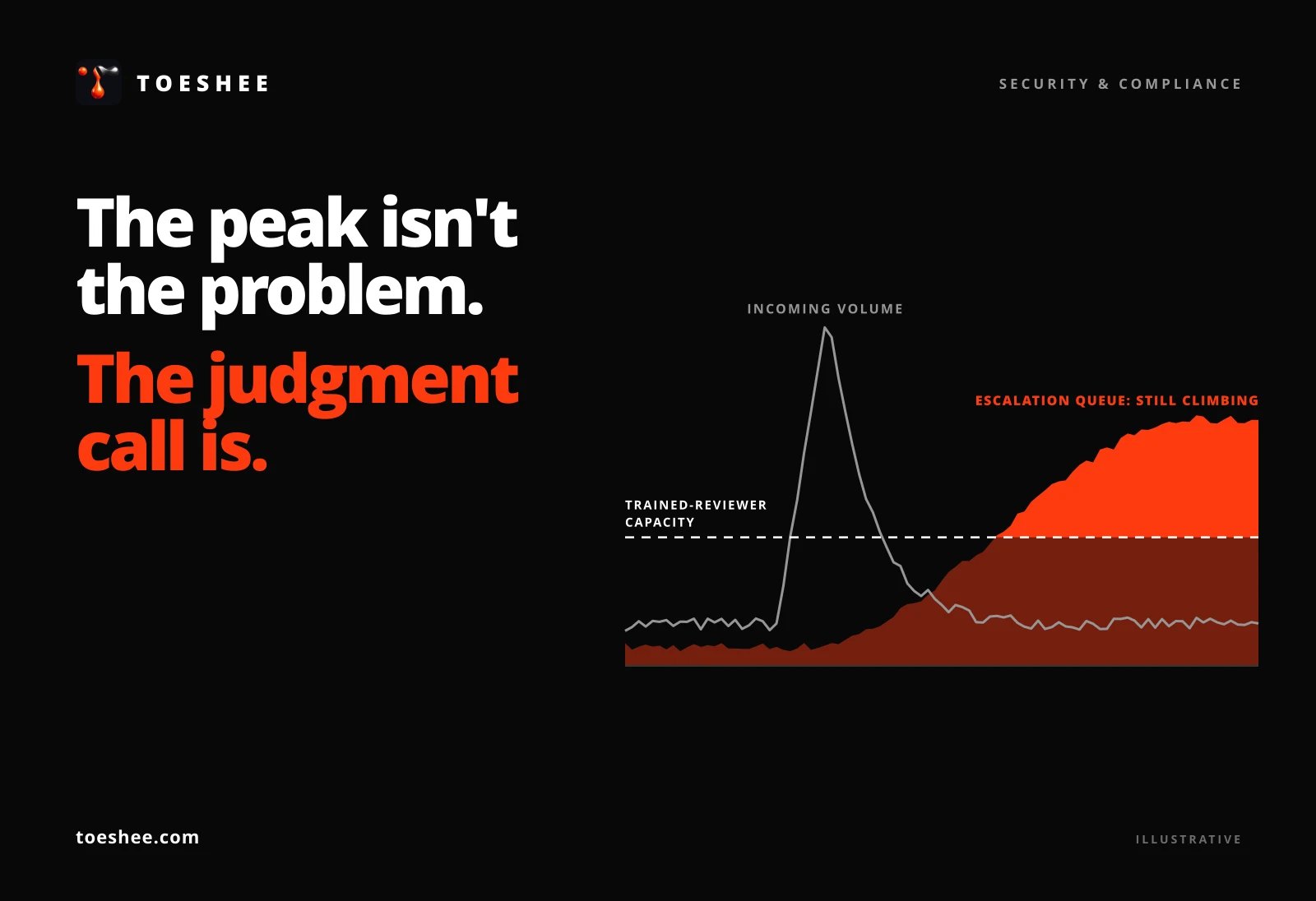
A surge in players, transactions, or market activity doesn't break compliance because the queue gets longer. It breaks because the cases that need a judgment call, not a rule lookup, pile up faster than a trained reviewer can clear them.
Automated screening already handles the routine volume. What a spike actually tests is the layer underneath it, the one that can't be delegated to a script.
Our view, based on how we see the operational problem shift across the platforms we work with: two or three years ago, the gap most platforms needed to close was coverage, enough people, enough hours, enough languages. Automation has closed most of that gap for routine tickets and for predictable KYC and transaction screening. What's left exposed is narrower and harder to staff for: the share of cases that need a person's judgment, not a script, which is exactly the share a spike multiplies first. This is our framing of the problem, not a finding from an external study.
Three things that don't scale the same way
1. Screening
Scales with tooling and with more trained capacity. A rules engine or an added reviewer both move this number in a straightforward way.
2. Escalation
Scales with how fast a trained, accountable person can be put in front of a case, with enough context to decide well the first time, not the third.
3. Trust
Doesn't scale inside a single spike at all. It's the thing being protected while the first two catch up.
Most volume plans size for the first one and assume the other two will hold on their own. What that looks like when it's tested in public is the Cronos case below.
Common questions
How do compliance operations handle volume spikes?
Not all of it the same way. Automated checks absorb the predictable load: standard KYC, routine transaction screening, pattern flags a rules engine already knows how to read. What a spike actually stresses is the small share of cases that need a person to weigh context, an edge-case verification, a disputed chargeback, an escalation that touches a live regulatory obligation. That share doesn't shrink because volume goes up. It just arrives faster, and a platform that measures only throughput can look healthy for days while that smaller queue is already backing up behind it, unseen.
What are shared operations in compliance?
Compliance-trained capacity that moves between accounts instead of sitting dedicated to one, so a business isn't staffing for its worst week year-round. A recent FCA review of 382 corporate finance firms in the UK found that 90% already run some part of compliance through outside support, which the regulator treats as legitimate as long as the firm keeps active oversight of what the third party does. That review covers UK corporate finance, not iGaming, fintech, or digital assets, so it's a signal from an adjacent regulated market, not a finding about this one.
The same review found that 63% of those firms have a compliance function that isn't dedicated solely to compliance; it also carries other business responsibilities. The FCA flags that directly as a conflict-of-interest risk when compliance participates in revenue generation. Read together with the 90% outsourcing figure, the picture is a function that is frequently shared both externally, with a third party, and internally, with other business priorities. Outsourcing execution is something the regulator accepts. A compliance function that is also stretched internally, with no dedicated owner even before volume spikes, is a different and harder problem.
The review found three baseline activity gaps before any volume event was factored in:
- 90 firms had no whistleblowing channel.
- 82 firms had no breach register.
- 82 firms had no annual compliance report to the governing body.
A shared-operations model doesn't need to solve all of them, but it does need to be evaluated against them specifically: whether the function it's supporting actually has a place for an issue to be escalated, logged, and reported, not just a team to route tickets to.
How do regulated businesses stay compliant at high volume?
By keeping screening, escalation, and trust separate in practice, not just on a planning document. iGaming, fintech, and digital-asset platforms each hit this at a different trigger, a promotion, a market move, an on-chain event, but the mechanism is the same: a model built only for forecastable growth has nothing ready for the volume that doesn't ask permission first.
What breaks first when compliance operations scale?
The hand-off between tiers. Routine throughput often holds under pressure, because it's the part everyone plans for. What degrades first is the path a case takes once it needs escalation: context gets lost between the agent who flagged it and the reviewer who has to decide, and cases stack at the point requiring sign-off.
The exploit created the loss. The rollback created the support question.
On August 30, 2026, an attacker inflated the price of Tectonic's low-liquidity governance token roughly 100 times in about 20 minutes, used it as overvalued collateral, and borrowed $120.4 million. Cronos halted block production within minutes and validators executed a reversal of 10,961 blocks — 1 hour and 54 minutes of chain history — rolling back to block 90,896,188.
The rollback recovered approximately $111.2 million, about 92% of the total, according to figures reported by TRM Labs and The Block. The remaining $9.19 million, 7.6%, had already crossed a bridge to Ethereum and was not recovered.
The reversal also undid every other transaction inside that window, whether or not it had anything to do with the exploit. Cronos's own postmortem, as reported by The Block, describes the decision as weighing the finality users expect from a chain against the funds at risk, and states that no action was required from affected users. TRM Labs separately reports that price-manipulation attacks like this one hit an all-time high in 2026, now roughly 1 in 8 of all crypto hacks, up from 1 in 17 in 2022.
The original exploit created the financial loss. The remedy, a rollback touching every transaction in a two-hour window, is what created the operational and support question for everyone caught inside it.
A few questions worth asking before the next spike
- If volume doubled this week, would your judgment-call layer know it, or only the dashboard that measures throughput?
- Who is watching the escalation queue right now, and is it the same person also clearing routine cases?
- If part of your compliance function already runs through outside support, who owns the oversight of that support, on paper and in practice?
- Could your current model absorb a market event or a campaign spike without borrowing headcount from somewhere else first?
Risk management is the design principle behind how we built this: not a checklist added after the workflow exists, but the frame the workflow is built inside from the start. We wrote about what happens when consistency, not capacity, is the thing under pressure in Compliance operations under volume pressure. That piece covers the operating model for sustained growth. This one is about the spike that doesn't ask first.
We've got your back. Crypto-native.